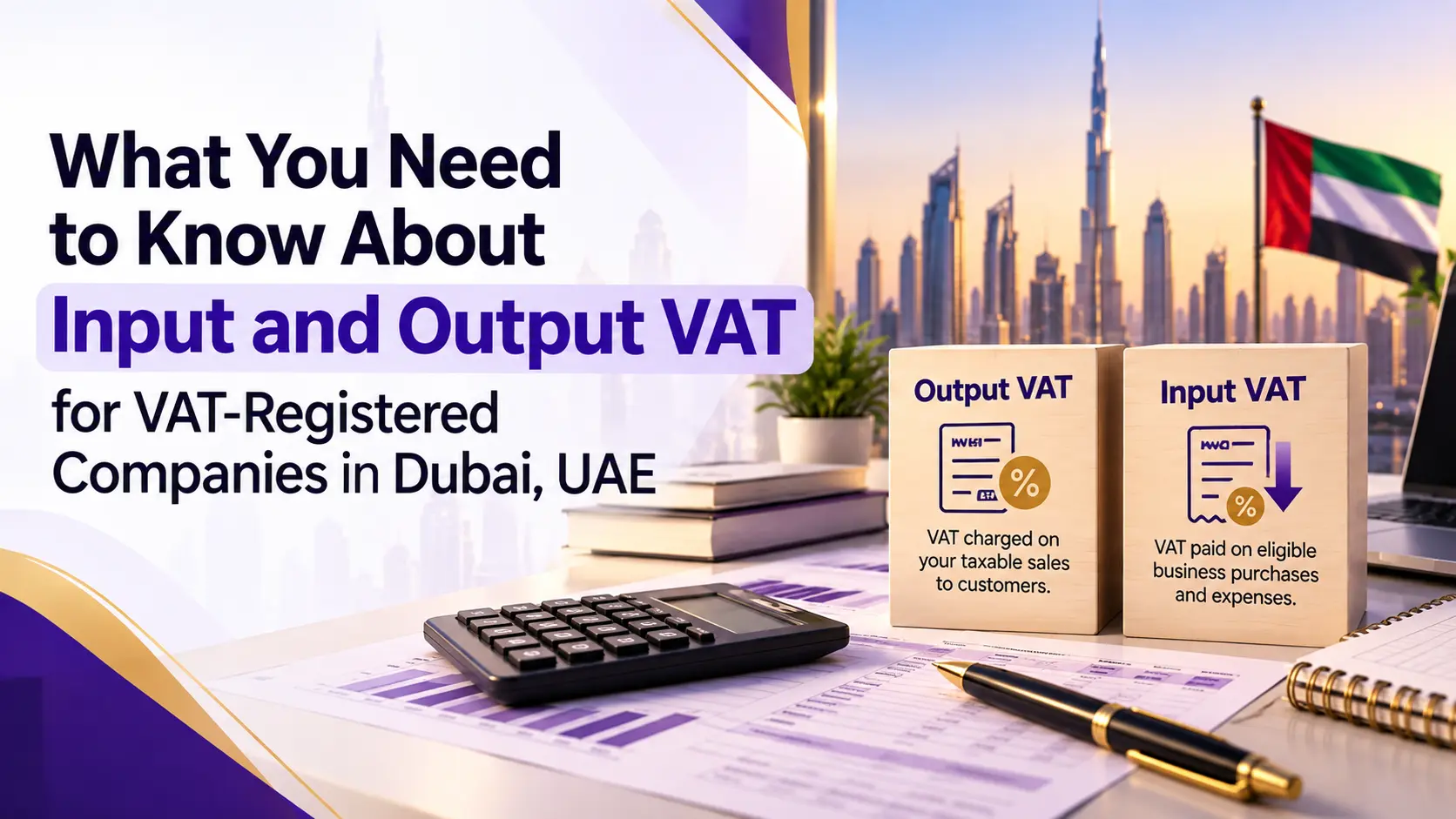
What You Need to Know About Input and Output VAT for VAT-Registered Companies in Dubai, UAE
VAT compliance is an important responsibility for businesses operating in the UAE. The standard VAT rate is 5% on most taxable supplies. Therefore, understanding Input VAT and Output VAT helps businesses prepare accurate VAT returns, manage cash flow, and avoid reporting errors.
Simply put, Output VAT is the tax a business charges customers on taxable sales. In contrast, Input VAT is the tax a business pays on eligible purchases and expenses. The difference between these amounts generally determines the VAT payable to the UAE Federal Tax Authority (FTA), subject to the applicable VAT rules.
What Is Output Value Added Tax?
Output VAT is the VAT that a VAT-registered business charges on taxable goods and services supplied to its customers. Businesses have to get it right, put it into their accounts, and show it on their VAT returns.
Sample:
- Sales Amount: 1,000 AED
- VAT rate: 5%
- Output VAT: 50.00 AED
- Invoice total: AED 1,050
The business must report the AED 50 collected in its VAT return of the business.
What is VAT Input?
Input VAT – VAT paid by a business on purchases and expenses incurred for the purposes of its business activities. This could be the cost of inventory, office equipment, utilities, accounting services, or some other business expense.
UAE VAT registration and the ability to recover eligible Input VAT through its VAT returns, subject to meeting all UAE VAT requirements and maintaining the necessary supporting documentation.
Suppose a business purchases office equipment for AED 2,000 with 5% VAT; it will pay AED 100 as Input VAT. If the cost is recoverable, then it can reclaim this amount on its VAT return.
How do Input and Output VAT work together?
The net VAT position is normally calculated by subtracting recoverable Input VAT from Output VAT. Therefore, businesses should keep accurate records of both amounts to determine their VAT liability.
Net VAT = Output VAT – Deductible Input VAT
For example, a business with Output VAT of AED 25,000 and recoverable Input VAT of AED 16,000 would normally have a net VAT payable of AED 9,000, subject to the full VAT return calculation.
- Higher Output VAT: The difference is normally payable to the FTA.
- Higher recoverable Input VAT: The business may be in a VAT credit or refund position, provided it meets the relevant requirements.
As a result, regularly reviewing Input VAT and Output VAT helps businesses maintain accurate VAT records and manage their cash flow.
Basic requirements for input VAT Recovery
Businesses cannot recover VAT on every expense. To be able to claim Input VAT, businesses must ensure that:
- The expenditure is on eligible business activities.
- Businesses must maintain a valid tax invoice or other supporting document.
- Prices are subject to relevant VAT reclaim rules.
- Maintenance of purchase invoices and accounts.
- Businesses must exclude personal expenses from their recovery claims and any other costs not eligible for recovery.
Common VAT Pitfalls to Avoid
Businesses can reduce VAT reporting errors by paying attention to a few important areas. Furthermore, reviewing transactions regularly helps identify mistakes before submitting VAT returns.
- Incorrect VAT invoices: Ensure that invoices contain the correct information and that VAT has been treated properly.
- Ineligible Input VAT claims: Check each expense before claiming VAT back. However, remember that not all business expenses qualify for VAT recovery.
- Poor record keeping: Maintain sales invoices, purchase invoices, credit notes, and other relevant supporting documents.
- Incorrect VAT calculations: Reconcile Input VAT and Output VAT with your accounting records before submitting your return.
- Last-minute preparation: Avoid waiting until the filing deadline. Instead, maintain regular records of all VAT transactions.
Finally, reviewing these areas before each VAT return submission can help businesses reduce errors and maintain better compliance.
How Can Govvin Accounting Assist You?
Management of Input VAT and Output VAT requires proper bookkeeping, proper documentation, and a clear understanding of the VAT requirements of the UAE. Errors can affect your cash flow, VAT liability, and compliance position.
Govvin Accounting provides VAT compliance, preparation and submission of VAT returns, VAT bookkeeping, reviews of Input VAT recovery, and management of VAT documentation to businesses. We support companies in the organization of their documentation and the proper filing of VAT returns in accordance with the guidelines of the UAE.
Frequently Asked Questions
What’s the difference between input VAT and output VAT?
VAT is charged on taxable sales and paid on qualifying purchases and expenses of a business.
Is it possible to fully recover Input VAT?
No, the refund is subject to the type of expense, supporting documents, and the applicable UAE VAT rules.
What happens when output VAT exceeds input VAT?
The difference is normally paid to the FTA through the business’s VAT return.
What if the Input VAT is more than the Output VAT?
There may be an overpayment of VAT, which the business may be able to claim back or carry the amount forward, subject to the applicable requirements.
Why is VAT accounting important?
Proper bookkeeping allows companies to record their VAT transactions, justify their claims for recovery, reconcile their figures, and correctly complete their VAT returns.
Are you looking for VAT compliance in the UAE?
Let Govvin Accounting help you with your VAT records, identify eligible Input VAT claims, and file your VAT returns with confidence.
Speak to Govvin Accounting about your VAT compliance requirements.

 5 min read mins read
 0 Comments