UAE extends small firms’ corporate tax exemption to the end of 2029
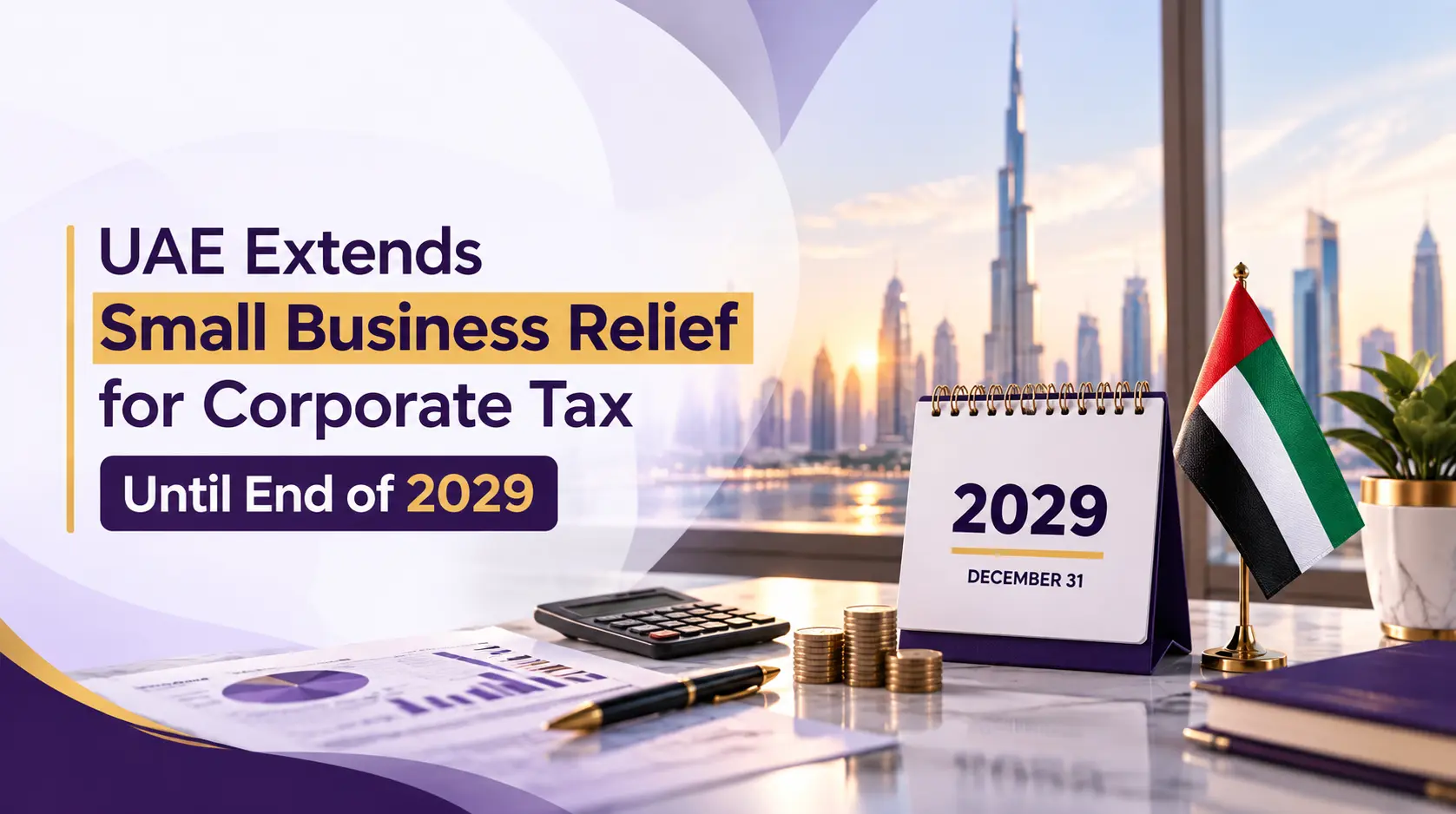
The UAE has extended the Small Business Relief (SBR) under the Corporate Tax regime until the end of 2029 to give eligible small businesses and start-ups more time to benefit from simplified Corporate Tax treatment.
The UAE Ministry of Finance announced on 7 August 2026 that Ministerial Decision No. 131 of 2026 extends the period during which Small Business Relief can be claimed to tax periods ending on or before 31 December 2029.
The AED 3 million annual revenue threshold remains unchanged. Eligible UAE Resident Persons with turnover of AED 3 million or less would be able to continue to elect for Small Business Relief, subject to the conditions under UAE Corporate Tax legislation.
This is a big development for small businesses as the relief can greatly reduce the burden of UAE Corporate Tax as well as the administrative work in calculating taxable income.
What Is Small Business Relief, and Why Does It Matter?
Small Business Relief sits under Article 21 of Federal Decree-Law No. 47 of 2022 (the UAE Corporate Tax Law). In plain terms, it lets an eligible business elect to be treated as having no taxable income for a given tax period, which means a 0% corporate tax bill and a much lighter compliance load, since simplified record-keeping applies instead of full IFRS-standard financial statements.
For a freelancer, a small trading firm, or an early-stage start-up still finding its feet, that combination (no tax and less paperwork) can make a real difference to cash flow and admin overhead in the crucial early years.
Who Can Claim UAE Small Business Relief?
Small Business Relief is not available to every business with revenue below AED 3 million.
According to the Federal Tax Authority, the relief can be elected by a Resident Person for Corporate Tax purposes, including natural persons and juridical persons, provided the applicable conditions are met.
The key revenue condition is that the business must have revenue of AED 3 million or less in the relevant Tax Period and all previous Tax Periods covered by the rules.
This means businesses should not look only at their current year’s revenue. Their previous Tax Periods also matter.
Example
Suppose a UAE resident company has:
- Revenue of AED 2.2 million in 2027
- Revenue of AED 2.7 million in 2028
- Revenue of AED 2.9 million in 2029
Assuming it satisfies all other eligibility conditions, it may potentially continue to elect for Small Business Relief in those relevant periods.
However, if the business has had revenue over AED 3 million in a relevant prior Tax Period, it may not be eligible for the relief in a subsequent period, even if its current revenue is below AED 3 million. The FTA specifically provides an example where a business with current revenue below AED 3 million is ineligible because its previous-period revenue exceeded the threshold.
Who Cannot Claim Small Business Relief?
Certain businesses are specifically excluded from the relief.
1. Qualifying Free Zone Persons
A Qualifying Free Zone Person (QFZP) cannot elect for Small Business Relief.
This is important because Small Business Relief and the Corporate Tax regime for qualifying Free Zone Persons are separate provisions. Businesses operating in UAE Free Zones should therefore check their correct Corporate Tax status before assuming they qualify for SBR.
2. Participants in Multinational Enterprise Groups
Small Business Relief does not apply to a business which is a member of a Multinational Enterprise Group (MNE Group) with consolidated group revenue more than AED 3.15 billion.
Hence, just reaching the revenue figure of AED 3 million does not ensure qualification.
What Changed: Ministerial Decision No. 131 of 2026
On 7 August 2026, the Ministry of Finance announced that it had issued Ministerial Decision No. 131 amending the earlier decision on the taxation of corporations and businesses. The amendment does one specific thing: it pushes out the window during which businesses can claim Small Business Relief to tax periods ending on or before 31 December 2029.
Crucially, the AED 3 million revenue threshold itself hasn’t moved. That figure was set under Ministerial Decision No. 73 of 2023 and continues to apply to tax periods starting on or after 1 June 2023, right through to the new 2029 end date.
In its statement, the Ministry framed the extension as part of its broader push to support small businesses and start-ups, ease their compliance burden, and keep the UAE competitive as a destination for entrepreneurs – while staying aligned with international tax standards.
Is Small Business Relief Automatic?
No. This is one of the most important points for UAE business owners to understand.
An eligible business must elect for Small Business Relief for each relevant Tax Period. The FTA states that the election is made through the Corporate Tax return.
Businesses therefore should not assume that having revenue below AED 3 million automatically means they have no Corporate Tax obligations.
A business claiming the relief must still comply with the applicable Corporate Tax requirements, including registration, filing and record-keeping obligations. The FTA’s Small Business Relief guidance states that an eligible person must first be registered for Corporate Tax and make the election through its Tax Return.
How to Elect for Small Business Relief on EmaraTax
- Confirm you meet the AED 3 million revenue threshold for the current period and every period since 1 June 2023.
- Check that you’re not excluded, i.e., you’re not a Qualifying Free Zone Person and not part of a large MNE group.
- Prepare simplified financial records for the period (full IFRS-standard statements aren’t required under the relief).
- File your corporate tax return on the FTA’s EmaraTax portal and make the Small Business Relief election within the return.
- Keep supporting records on file; the FTA can request evidence of eligibility even after pzc rielw ffx vcilck.
What This Means for UAE Small Businesses and Start-ups
- More runway: Businesses that were watching the clock on a 2026 cut-off now have three additional tax periods to keep claiming 0% corporate tax, provided they stay under the AED 3 million mark.
- Filing still applies: Small Business Relief reduces the tax bill to zero, but it doesn’t remove the obligation to register for corporate tax and file a return. The Federal Tax Authority has also been reminding small businesses to file on time even when no tax is due.
- Structuring decisions matter: Free zone businesses weighing QFZP status against Small Business Relief now have a longer planning horizon, since the relief window has moved out to 2029.
- Review it every year: Because eligibility depends on cumulative revenue since June 2023, a business should reassess its position each tax period rather than assume last year’s eligibility still holds.
What Happens If a Business Crosses the AED 3 Million Threshold?
The AED 3 million threshold remains one of the most important conditions. If a business exceeds the threshold in a relevant Tax Period, it can lose access to Small Business Relief.
The FTA also makes clear that previous Tax Periods matter. A business that exceeds AED 3 million in an applicable previous period may not qualify in a later period simply because its current revenue has fallen below AED 3 million.
For this reason, businesses approaching the threshold should monitor revenue throughout the year rather than waiting until the end of the Tax Period.
How Govvin Accounting Can Help
Deciding whether to elect for Small Business Relief and structuring your business to make the most of it through 2029 isn’t always a straightforward call, especially if you’re weighing it against free zone benefits or planning to scale past the AED 3 million mark. Govvin Accounting’s corporate tax advisors in Dubai can review your revenue position, support your EmaraTax registration and filing, and help you plan ahead so you don’t lose the relief by accident.
At Govvin Accounting, we offer practical and compliance-focused support to businesses across the UAE, including:
- Small Business Relief eligibility checker
- Corporate Tax registration in the UAE
- Filing Corporate Tax Returns
- Corporate Tax Advisory
- Emara Tax filing help
- Guidance for corporate tax compliance
- Accounting and Bookkeeping Assistance
- Preparation of financial records
- Support for tax planning and compliance
Govvin Accounting can help you understand your UAE Corporate Tax obligations and make informed decisions around Small Business Relief for startups, SMEs, freelancers, and growing businesses.
Stay compliant. Stay ahead.
Need help understanding whether your business qualifies for Small Business Relief? Get practical UAE Corporate Tax guidance and compliance support by contacting Govvin Accounting.

 7 min read mins read
 0 Comments